
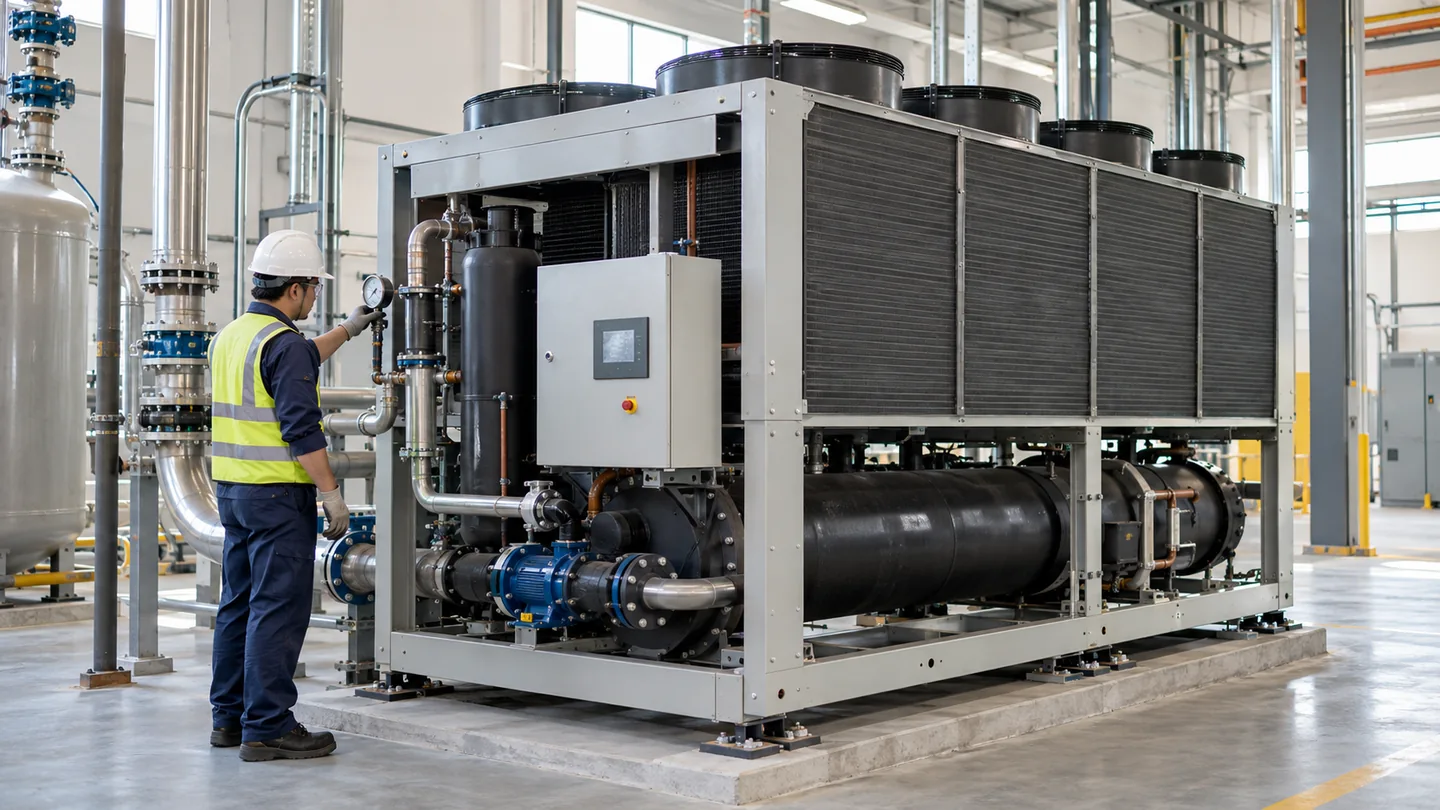
Do not size a chiller by horsepower alone
An industrial water chiller removes heat from a process and rejects it through a refrigeration circuit. Catalogue tonnage or horsepower is useful for an initial shortlist, but actual performance depends on the process heat load, entering and leaving fluid temperatures, flow rate and ambient air temperature. Two models with the same headline rating may therefore deliver different results at your site.
Browse TEAM A→Z’s industrial water chiller category to compare configurations. This air-cooled industrial chiller listing is a starting point for a request—not a substitute for a duty-point calculation and written manufacturer confirmation.
Include these details in the RFQ
1. Identify the fluid: water, a water-glycol mixture or another process liquid.
2. State entering and required leaving temperatures, flow rate and daily operating hours.
3. Provide the cooling duty in kW. If it has not been calculated, share the process description and the equipment that releases heat.
4. Give the expected summer ambient temperature, installation location and ventilation constraints.
5. Specify electrical supply, phases and frequency, and ask the supplier to confirm compatibility in writing.
Compare the complete offer
Ask for capacity at your actual design conditions, power consumption, compressor type, sound level, dimensions and refrigerant. Confirm whether a pump, tank, filter, controls and remote monitoring are included. Dual circuits or a standby unit may make sense where downtime is costly, but the decision should follow a risk and cost assessment.
Request a selection sheet for the stated duty point, dimensional drawing, wiring diagram, warranty terms, maintenance plan and spare-parts list. “Same capacity” is not a useful comparison unless the water and ambient temperatures behind that rating are also stated.