
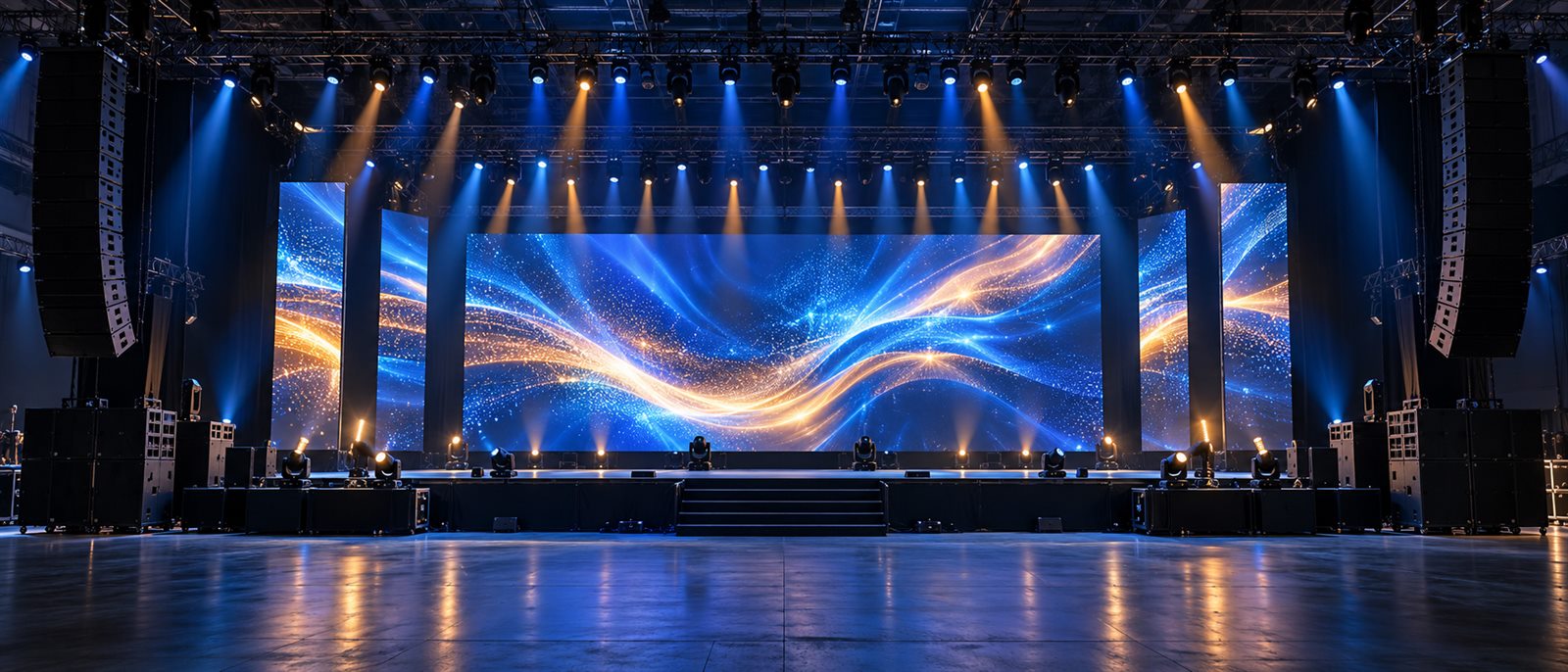
Event equipment from China is often sourced as a complete package: an LED screen with a video processor, loudspeakers with amplification, stage lights with control, plus truss, staging and power distribution. The goal is not to collect separate devices. It is to specify a compatible system for a particular venue, audience and show format.
Before requesting prices, prepare a short brief: event type, indoor or outdoor venue, stage dimensions, approximate viewing distance, audience coverage, installation deadline, available power and budget. These details help suppliers quote comparable configurations.
LED screens and video walls for events
Start LED display selection with viewing distance and image size. Choose pixel pitch around how close the audience will be and the level of detail required: the closer the audience, the more carefully pixel density needs to be assessed. For outdoor use, confirm daylight brightness, dust and moisture protection, and the operating environment. For indoor use, consider comfortable brightness, colour reproduction and camera performance without visible flicker.
Ask for the exact cabinet model, pixel pitch, refresh rate, brightness, front or rear service access, cabinet weight and mounting method. The package should align LED modules, receiving cards, power supplies, a sending controller or video processor, spare modules, and power and signal cables. Confirm whether rigging hardware, flight cases, interconnects and spares are included.
Check that the video processor inputs and formats match the signal sources at the venue. Before dispatch, request video of the powered screen, a colour test, a check of every cabinet and photos of serial labels. Compare options in the LED screens and video walls category.
Professional concert sound systems
For a live show, even coverage matters more than choosing the loudest speaker. Describe the width and depth of the audience area, indoor or outdoor use, suspension height and expected audience size. Ask for a proposed layout of line arrays, subwoofers and stage monitors, along with coverage information and the required amplification.
Match loudspeakers with amplifiers and DSP by power, impedance, presets and connection method. Get an itemized package list: speaker cabinets, subs, amplification, processor, mixing console, digital stage box, monitors, microphones, stands, cables and cases. For a digital mixer, check its input and output list, supported protocols and compatible stage box. For wireless microphones and in-ear monitoring, confirm that the frequency range suits local use and the venue.
As a starting point, browse professional concert sound systems, digital mixing consoles and audio processors and a sample dual 10-inch line-array listing. Confirm the specifications and package of any specific offer with the supplier before payment.
Stage lighting and control
Select fixtures for the show: beam for defined shafts, spot for accents and gobos, wash for broad colour, and LED PAR or profile fixtures for stage coverage. For each fixture, confirm the light source, optics, beam angle, brightness, cooling noise, dimming and permitted duty cycle.
The control system should fit the fixture count and venue layout. Check support for DMX512, RDM or Art-Net/sACN, the number of universes, connector types and signal backup. Ask whether addressing and settings survive a power interruption and whether the manufacturer supplies an English manual. Confirm that fixtures fit the chosen truss and include suitable clamps and safety bonds.
Truss, staging and power
For LED and speaker rigging, request drawings, material details, connectors and documented rated loads. A qualified specialist should calculate load-bearing structures and suspension based on equipment weight, geometry and dynamic loads. Do not select truss by appearance alone.
List the power draw of each device, number of circuits, connectors, cable lengths and venue protection requirements in the brief. A qualified local professional should check the electrical plan and installation. Confirm local supply parameters and connector standards before custom cables or distribution units are made.
What to request from a supplier
- An itemized specification with manufacturer, model, quantity and included accessories for every line.
- Photos and video of the exact offered model, including rear panels, labels, connectors and package contents.
- Dimensions and packed weights; for truss and staging, connection drawings and load documentation.
- Payment terms, production lead time, warranty, spare-parts availability and the process for resolving defects.
- Packing and export-shipping terms, plus clear labels for every package.
- A sample check or pre-shipment inspection when the order value and project risk justify it.
Compare quotes against the same specification. A lower price may exclude a controller, amplification, brackets, spare modules, cables, cases or freight. To estimate logistics, collect the dimensions and weight of each package, packing type, destination and required delivery window in advance.
Equipment examples in the catalog
For an initial comparison, see a rental LED screen listing for events and a dual 10-inch line-array system listing. These are examples of supplier listings, not guarantees of stock or final configuration. Confirm current pricing, specifications, terms and availability before placing an order.
Frequently asked questions
How do I choose LED screen pixel pitch?
Consider viewing distance, screen size and required detail. Before payment, request a cabinet layout and video of the image viewed from the intended distance.
Is a line array enough on its own?
Usually the complete audio chain needs to be coordinated: subwoofers, amplifiers, DSP presets, mixer, stage box, monitoring, rigging, power and cables. The package depends on the venue and event.
What should I check on stage lighting fixtures?
Confirm fixture type and optics, DMX or network protocols, connectors, cooling, mounting method and safety hardware.
How can I reduce risk when sourcing event equipment from China?
Agree the specification and acceptance criteria in writing before payment, check a sample or complete package, confirm packing, and inspect equipment before dispatch. Keep supplier correspondence and written approval for every change.
If you are equipping a concert, festival, rental company or conference venue, browse the event equipment category and send the venue dimensions, event format and required items.