
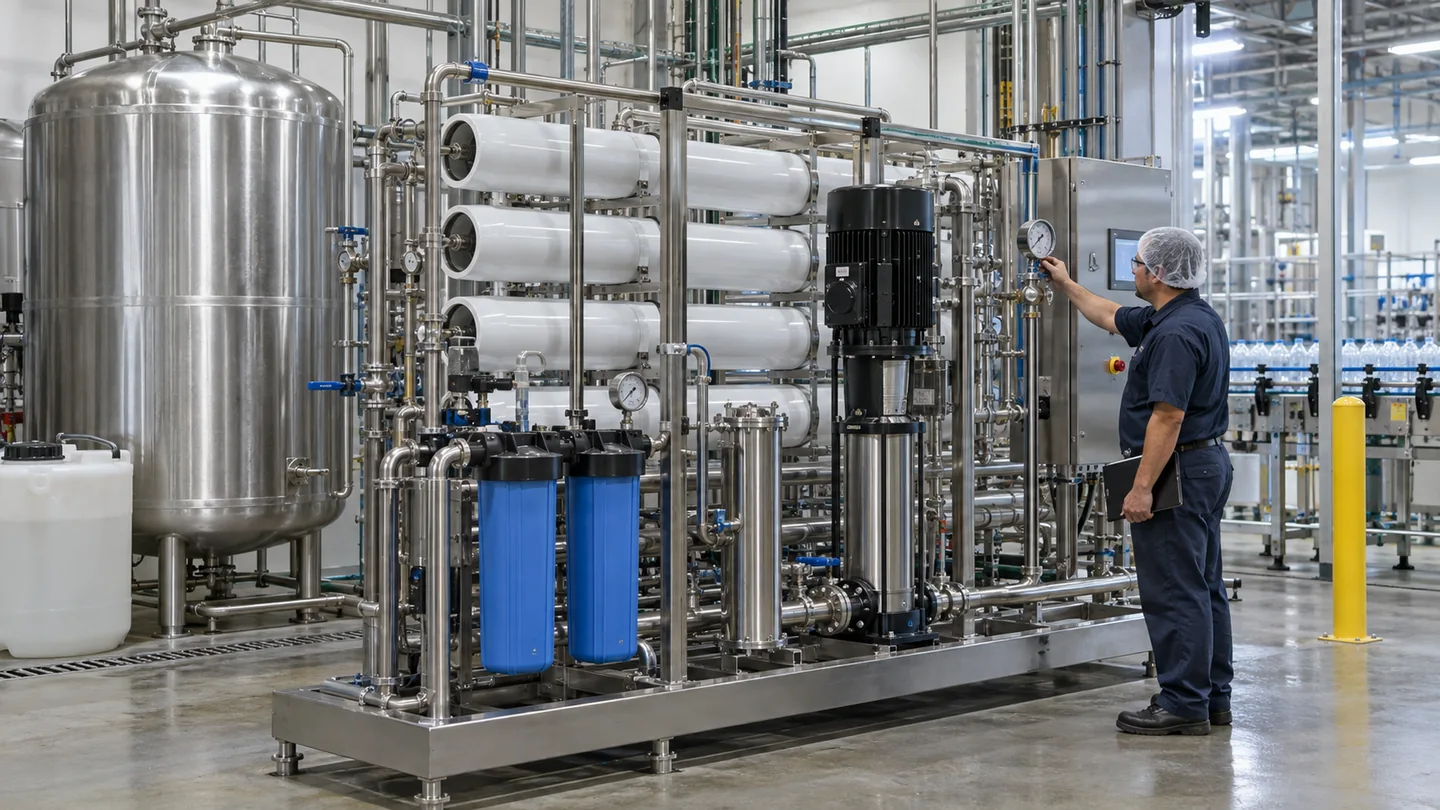
Start with a feed-water test, not a catalogue
An industrial reverse-osmosis (RO) system uses membranes to reduce dissolved salts. The same unit will not perform identically on well, municipal or brackish water: feed chemistry, temperature, required product-water quality and operating schedule all change the design.
TEAM A→Z lists industrial reverse-osmosis systems and broader water-treatment equipment. Use these categories to explore configurations, then have the supplier size the equipment against a current water analysis and your process requirement.
What to include in the RFQ
- Source and laboratory analysis: TDS, hardness, iron, silica, free chlorine, temperature and microbiological indicators.
- Required output in litres per hour or cubic metres per day, with average and peak demand separated.
- The process using the treated water and the quality standard the final water must meet.
- Ask for the pretreatment train, membrane model, design pressure and calculated permeate recovery.
- Agree how concentrate will be handled, what cleaning chemicals are needed and how water loss is managed.
Compare the full operating picture
Check pump materials and redundancy, membrane vessels, automation, conductivity/TDS monitoring, alarms, filter-change intervals and consumables availability. For food, pharmaceutical or drinking-water use, an RO skid does not by itself prove compliance; final-water testing and additional treatment may be required.
Ask for a selection sheet based on your feed-water test, process-flow diagram, electrical requirements, annual consumables list, warranty and service plan. A headline “tonnes per hour” figure alone does not show power use, recovery ratio or expected membrane life.